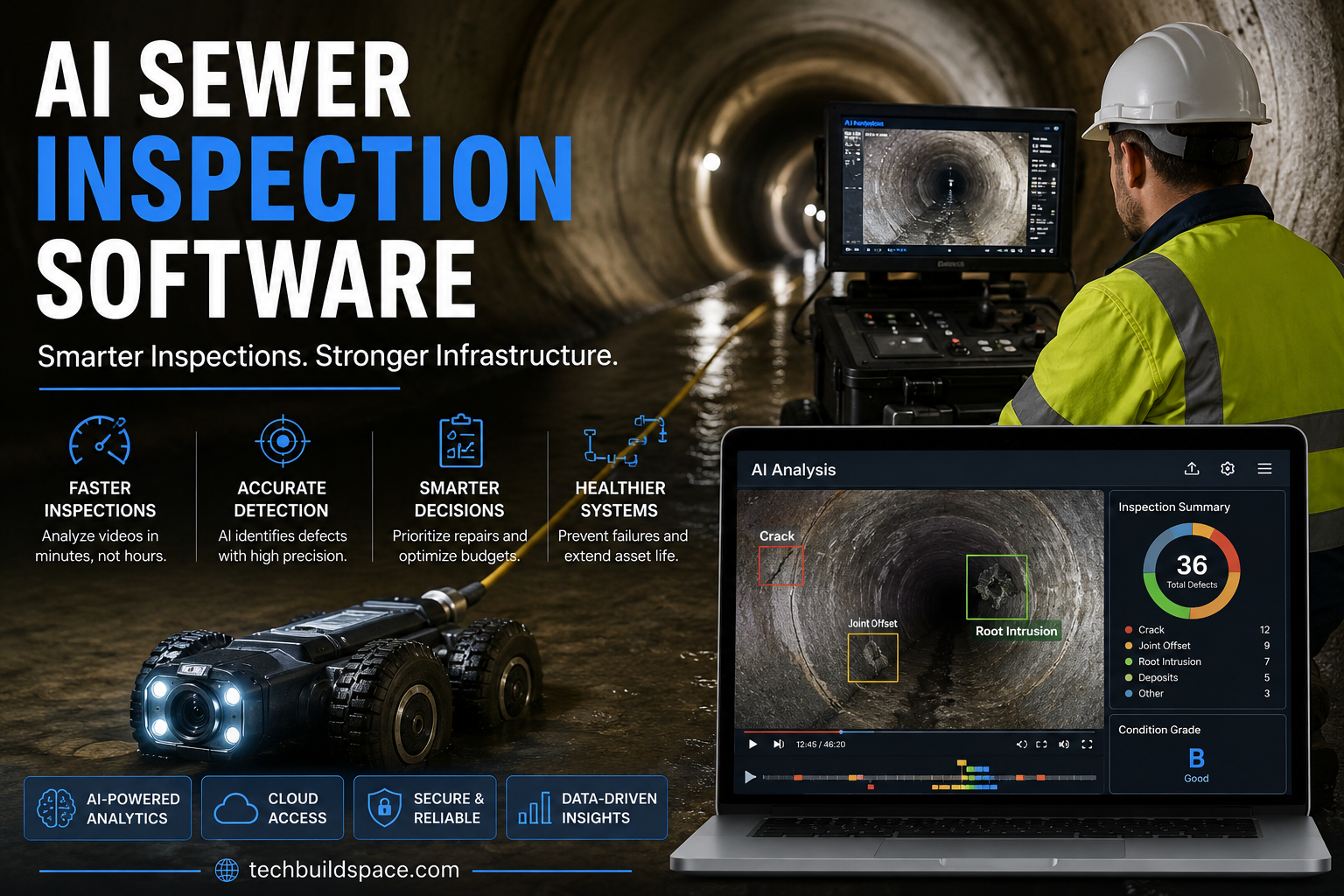
How Municipal Teams Transform Workflows with AI Sewer Inspection Software
In every city, there are countless stories buried within its roads. Aging sewers, clogs, and cracks can all develop into costly situations without notice. For years, inspection teams have worked using cameras, analysis, and viewing each frame manually. Today, however, ai sewer inspection software is making this process easier by assisting cities and construction teams in identifying issues earlier and determining their priorities with confidence.
It is not a matter of taking away the job of an inspector and handing it over to technology. Instead, inspectors will be getting better tools to work with that reduce repetitive tasks and allow those who have years of experience to make choices based on judgment rather than laborious processes.
Why Sewer Inspection Required a New Way of Thinking
Just a few years ago, a medium-sized city had to deal with an increase in flooding complaints caused by rainstorms. Although they had a huge number of CCTV video recordings of the sewers, analysis of all the videos took a lot of man-hours for the staff. By the time the defects were identified, the repair cost was even higher due to water damage.
Cases like that exist in many cities’ public works departments. Sewer systems are enormous, aging, and almost impossible to see until some problems occur. Manual inspection is still useful but faces three constant challenges:
Long-time video analysis: It can take hours for an inspector to analyze the video of a small piece of pipeline.
Subjectivity of defect detection: Different people might interpret the same cracks or joint separation differently.
Infrastructure inspection backlog: A city can have more pipelines to check than employees for the analysis.
New ways of thinking were required because the amount of data just keeps increasing without budget and staff growth.
What AI Brings to the Inspection Process
AI is not a replacement for the camera moving inside the pipe. Rather, AI looks at the footage taken and automatically detects the possible defects. The program is able to detect patterns of cracks, fractures, roots, grease, corrosion, offset joints, and other common sewer defects.
However, the key benefit of using AI technology is the speed. It is no longer necessary to start with an empty screen but instead have a list of defects that have been automatically detected by the software. All that needs to be done then is to double-check these findings.
This way, the workflow changes to the following one:
- Record CCTV footage using standard inspection equipment.
- Upload the video to the analysis platform.
- Receive automated defect detection and preliminary classification.
- Review flagged locations for accuracy.
- Generate reports and priorities for maintenance.
The result is a good combination of efficiency and reliability.
AI sewer inspection software for Faster Defect Detection
One of the most valuable capabilities is rapid defect identification across large inspection datasets.
By tradition, each minute of video footage needed special consideration. Automated analysis will allow the program to mark the segments where there are defects in construction or operation. The inspector may move straight to the point and make an assessment of whether there is a need for any actions.
This significantly reduces the time needed to review the video footage. By tradition, each minute of video footage needed special consideration. Automated analysis will allow the program to mark the segments where there are defects in construction or operation. The inspector may move straight to the point and make an assessment of whether there is a need for any actions.
This significantly reduces the time needed to review the video footage. Municipal teams can process more footage in less time, which means maintenance decisions happen sooner. Faster detection is especially important for problems such as
- Longitudinal and circumferential cracks
- Broken pipe segments
- Root intrusion
- Joint displacement
- Debris accumulation
- Corrosion and surface deterioration
The earlier the problem is detected, the less costly and invasive the repair will be.
Improving Uniformity Among Inspection Teams
Skilled inspectors acquire pattern recognition capabilities through years of experience. Nevertheless, there remains individual variation in interpretations due to human error, even for slight defects or video inconsistencies.
AI-based analysis introduces standardized detection criteria. All videos are analyzed through the use of a standard model, thus minimizing variations in identifying defects at the preliminary stage. Human inspectors are still responsible for final approval, although their starting point is standardized.
This consistency becomes particularly valuable for organizations with:
- Multiple inspection crews
- Contracted CCTV providers
- Large regional sewer networks
- Long-term Asset Management Programs
The use of a standardized report allows for better year-to-year comparisons.
Reactive Repairs vs. Predictive Maintenance
Utilities were often reactive in their operations, reacting to a blockage, collapse, or resident complaints about backups.
With the help of modern inspection analysis, a more predictive approach can be adopted. Utilities use defect severity levels, material types, ages of pipelines, locations, and past inspection results to determine assets that will continue deteriorating until they fail.
A pipeline that exhibits moderate cracks and has root intrusion is not an immediate risk for replacement; however, it may soon become a top priority for repair during the next maintenance cycle. Predictive maintenance allows organizations to:
- Schedule repairs during planned construction windows
- Cut down on emergency excavation costs
- Limit disruptions to traffic
- Lengthen asset lifespan through selective rehabilitation
- Better manage budgets
The transition from being reactive to proactive in maintenance work can often lead to the biggest cost savings.
Compatibility with Existing CCTV Systems
A common concern among municipalities is whether adopting advanced software requires replacing expensive camera systems.
Often the answer will be no. Most current inspection systems will be built to support footage captured by current CCTV sewer inspection systems. The software is geared towards analysis of video and inspection data and not replacement of the camera hardware itself.
This makes for easy integration as agencies are able to enhance their analysis capabilities without immediately having to purchase a whole new set of inspection systems.
The common integration areas include:
| Existing Asset | How Software Integrates |
| CCTV crawler cameras | Video upload and automated analysis |
| Inspection reporting systems | Defect data export and report generation |
| GIS platforms | Pipe condition mapping and location tracking |
| Asset management software | Maintenance prioritization and work planning |
The goal is usually enhancement rather than complete replacement of established workflows.
Benefits for Municipal Utilities
Cities and wastewater agencies often manage thousands of miles of underground infrastructure with limited staffing. Automated inspection analysis provides several operational advantages.
Higher Inspection Throughput
Crews can process more footage within the same review period, allowing agencies to inspect a larger portion of their network annually.
Priority Setting for Budgeting
Scores and levels of defects allow decision-makers to use rehabilitation money to prioritize the most risky infrastructure first.
Enhanced Documentation
Automated timestamping, defect labeling, and structured reporting create more organized records for regulatory compliance and long-term asset management.
Knowledge Retention
When experienced inspectors retire, some institutional knowledge inevitably leaves with them. Standardized analytical tools help preserve consistent inspection practices across changing workforce generations.
Advantages for Contractors and Engineering Firms
Private inspection contractors also benefit from faster analysis and reporting
Project works usually have tight deadlines for delivering inspection reports to local governments, construction firms, or engineers. The automated detection of defects can speed up the process of preparing these reports, thus increasing efficiency in project work.
Additional advantages include:
- Faster turnaround for clients
- More consistent report formatting
- Reduced manual review workload
- Ability to handle larger project volumes
- Competitive differentiation in bidding processes
For engineering firms, standardized condition data supports rehabilitation design, pipe replacement planning, and capital improvement programming.
Challenges and Realistic Expectations
Though AI offers numerous benefits, it is not flawless, and its success depends on realistic expectations and effective monitoring.
Human Verification Is Still Necessary
Automatically detected objects should be checked by experienced inspectors before the final reporting. Such things as complicated defects, peculiar pipe material, excessive debris, or poor-quality videos may still need to be interpreted by a specialist.
Quality of Video Matters
Such factors as low-resolution videos, high water levels, lack of light, and camera vibrations may affect the quality of detection.
Model Performance Varies
Some platforms might exhibit superior performance on particular defect classes, material of pipes, or inspection environments. The pilot testing of software on local datasets is recommended before the full-scale implementation.
The best performance tends to be delivered by firms that consider AI an aiding tool instead of a completely autonomous inspector.
How to Evaluate a Software Platform
When comparing inspection analytics platforms, agencies should look beyond marketing claims and focus on operational fit.
Key evaluation criteria include:
| Evaluation Area | Questions to Ask |
| Detection accuracy | How was performance validated on real sewer footage? |
| Supported defect standards | Does it align with PACP, MACP, or local inspection standards? |
| Integration capability | Can it work with existing CCTV and asset management systems? |
| Reporting features | Are reports customizable for municipal requirements? |
| Cloud vs. on-premise deployment | Which option fits security, connectivity, and IT policies? |
| Training and support | What onboarding and technical assistance are provided? |
A short pilot project using actual local inspection footage often reveals far more than a product demonstration alone.
The Future of Underground Asset Management
The next stage of sewer infrastructure management is likely to combine automated video analysis with broader asset intelligence.
Trends emerging include:
- Predictive deterioration modeling
- GIS-based risk mapping
- Integration with work-order systems
- Real-time inspection dashboards
- Machine learning models that improve from verified inspection feedback
With more data becoming available through inspection, the analytical models would be increasingly precise in detecting and predicting future failures.
SEO-Friendly FAQs
Can AI replace sewer inspectors completely?
No. The technology is best viewed as a decision-support tool that automates video review and preliminary defect detection. Trained inspectors still verify findings and make final condition assessments.
Does the software require new CCTV camera equipment?
Many platforms are designed to analyze footage from existing sewer inspection cameras, allowing agencies to improve analytics without replacing their entire camera fleet.
Is automated defect detection accurate enough for municipal reporting?
Accuracy has improved significantly, but human verification remains important. Most agencies use automated detection to accelerate review while inspectors confirm and finalize reported defects.
What types of sewer defects can be identified automatically?
Common detectable issues include cracks, fractures, root intrusion, joint displacement, corrosion, debris accumulation, and structural deterioration, depending on the platform and video quality.
How does this technology help reduce maintenance costs?
Earlier defect detection supports preventive repairs, reduces emergency failures, improves project prioritization, and allows utilities to schedule rehabilitation before damage becomes more severe and expensive.
Conclusion
Cities often do not get credit for the good work done by their sewer systems; however, these sewer systems help protect people from diseases and other ailments on a daily basis. ai sewer inspection software allows utilities and contractors to save time, be more consistent, and make decisions about how to maintain the system in case any small problems turn into major issues with aging infrastructure.
The best results are obtained when both experienced inspectors and intelligent analytical software work hand in hand and not against each other. Companies that use this approach will be able to preserve underground infrastructure, maximize the budget for maintenance, and address challenges regarding infrastructure.










Post Comment