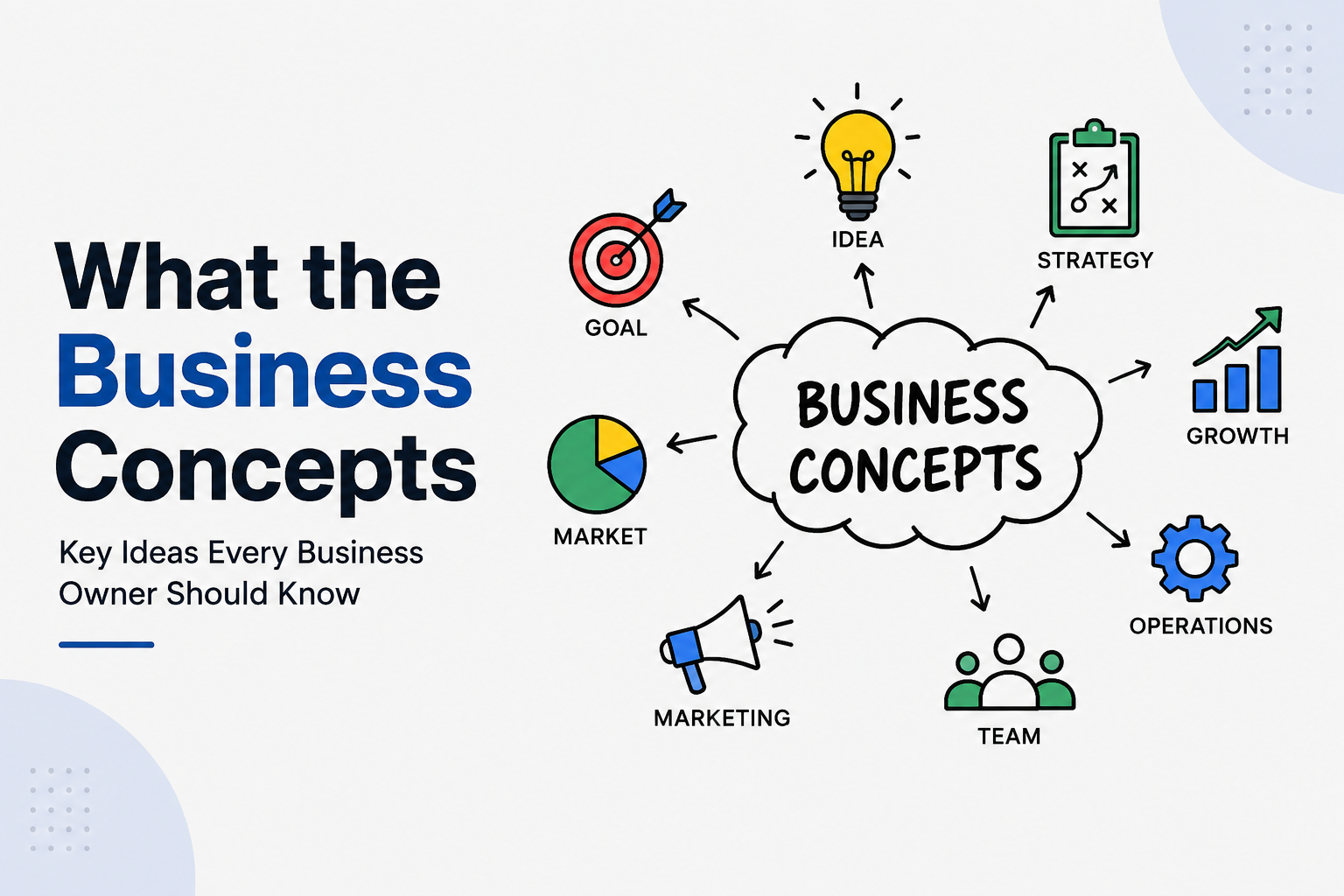
What the business concepts that shape successful companies?
What the business concepts Business ideas can be a basis for starting a business, but only having ideas will not help you achieve success. Whatever products or services, whatever marketing strategy, or whatever financial decisions that any business makes are based on fundamental business concepts. Business concepts tell the way business organizations work.
In order to find out what business concepts are, it is important to know about the concepts, which refer to basic ideas behind the working of businesses. Concepts refer to ideas associated with customers, creation of value, marketing, finance, operation, competition, and growth, and many more.
What Are the Business Concepts?
Basic business concepts are core ideas that show how companies create value, meet consumer needs, use resources, and achieve their goals. These concepts help explain why companies make certain choices and how different parts of an organisation work together.
For instance, although a company may produce a very good product, it is not necessarily guaranteed to succeed. The firm needs consumers willing to buy the product, a good way to reach them, a proper pricing strategy, and an efficient system for delivering the product.
Business concepts link these aspects.
Consider a bakery that starts as one individual selling home-made cakes. Initially, the owner may concentrate primarily on making good products. As orders increase, however, other issues arise. Who is the company’s best customer? What pricing approach should the firm use? What is the way forward with the ingredients? Which marketing channels should be chosen? Is it necessary to employ staff members?
Each of these issues relates to a particular business concept.
Customer Understanding
The client is usually the central point of any successful business. It is impossible to create sustainable value without being aware of whom the business serves and what he/she requires.
In order to have a customer focus, one needs to identify audiences, learn about their problems, study their preferences and design suitable products and services.
For instance, it may turn out that a clothes business will receive positive feedback from its customers regarding the importance of durability over fashion changes.
A business should not base its decisions on its own assumptions about the needs of customers. One can use surveys, reviews, interviews, purchase behavior analysis, and market research to learn about customers’ needs.
By understanding the target audience, the business will be able to make its decisions based on market needs.
Value Creation
Value creation is one of the core principles of a successful business. The customers spend their money, time or attention on goods and services that they consider valuable enough.
Value doesn’t always translate into the lowest price. The value created by a premium brand could be through quality, convenience, design, service, dependability, or even exclusivity.
Think about a business dealing with delivering meals. The business offers value by saving time of customers. In case the customers are busy, they will be ready to spend more on the product.
The successful businesses understand the value of their customers and create products and services based on that value.
Marketing and Branding
Even a great product will have difficulty succeeding without its existence known by prospective customers. The function of marketing is to convey the message to the desired audience of the company.
This involves activities including advertising, content creation, social media marketing, e-mail marketing, public relations, SEO, and promotions.
While marketing focuses on promoting the product, branding takes things a step further through the formation of the perception of the business. Through branding, it is possible for the company to convey its personality, quality, consistency, or any preferred lifestyle.
For instance, there could be two businesses offering similar products but having different brands because they have different positioning. While one is positioned based on low prices, the other business might be positioning itself as the provider of high-quality products.
Marketing is customer-focused and not product-focused.
Pricing and Revenue
Pricing is another important concept of business, as it affects the bottom line of revenue, perceptions, and profitability of businesses.
The calculation of price is not only about the cost of production. There are other factors that could be considered, including competitors’ prices, customer demand, value, market conditions, and positioning.
For example, an enterprise dealing in luxury products might rely on pricing for positioning purposes, while discount stores could go for lower pricing and higher sales volumes.
Revenue refers to the income earned by the business from the operations carried out. However, high revenue does not imply high profits; the firm can make huge sales but incur excessive expenditure in terms of production, marketing, and labour, among others.
It is for this reason that business managers must have an understanding of revenue and expenditures.
Profit and Financial Management
Profit is crucial to any business enterprise since it helps sustain it as well as grow.
Financial management is concerned with the management of income, expenditure, cash flow, budgeting, investments, and finances. It is possible to have an enterprise that performs well in sales but faces challenges in cash management.
For example, take an expanding company which takes an order but has to pay suppliers before getting payment from the client. In such a way, the company will be successful in the papers but will have some troubles regarding cash flow.
Knowledge of financial principles will give you a chance to foresee such events.
It is also important to differentiate necessary expenses from unnecessary ones in the business.
Operations and Efficiency
Operation is a set of processes a business implements for providing its products or services.
So for a restaurant it means buying ingredients, cooking, management of workers, serving, receiving payments, and keeping hygienic standards.
While operating, a company expands, and therefore it is difficult for it to use informal methods only. The standardization of processes, technologies, training employees, proper inventory management and other ways will allow increasing efficiency of operations.
Efficiency of operations does not equal working fast. It means working efficiently while providing the required level of quality.
Even small changes in the operations will provide big results in case they will be repeated many times.
Market Competitors and Positioning
Companies seldom work on their own; most companies face the competition from other organizations that provide similar products or services as alternatives.
By learning about competitors, businesses can determine the opportunities and threats associated with their operations. Some of the areas where comparisons could be made include pricing, product characteristics, customer service, marketing, and distribution.
But competing does not imply imitation of other companies.
The company can find an untapped customer base or a characteristic that is being neglected by the competitors.
In such a case, the company has an opportunity to occupy a unique market position.
For example, a local fitness company can realize that many local gyms target experienced athletes, and beginners feel awkward joining them. The company can differentiate itself by focusing on training beginners and giving them individual support.
Such an approach provides differentiation based on the customer needs.
Innovation and Adaptability
The market environment is changing constantly. New technologies, changing customer demands, economic situations and competitors affect the performance of the company.
The innovation enables the company to cope with these challenges. It involves the development of new products or services, the use of technologies, new ways of business processes, new approaches to reaching customers.
The innovation is not necessarily about creation of some new revolutionary invention.
Sometimes even the small changes in business operations can bring a great result. For example, the introduction of a convenient online order system can increase customer convenience even though the company did not invent anything new.
Strategy and Goal Setting
Business requires guidance. Through strategy, an organization is able to define where it wants to go and how it will do that.
While goals provide something specific and measurable, strategy sets the framework within which they will be achieved.
Thus, for example, an organization may set its goal in terms of increasing its customer base. In this case, its strategy may include entering a new market, customer retention, a referral programme, or increased digital marketing.
Good business goals are both realistic and measurable. Without clear objectives, it will be hard to say whether a business is really moving anywhere.
The strategy, on the other hand, helps businesses to decide which avenues not to explore. Due to limited resources, businesses need to concentrate on actions which correspond with their priorities.
Employees and Organizational Culture
People are the other key aspect of successful business operation. They bring to the organization their skills, knowledge, creativity, and labour, allowing the organization to function and develop.
In addition to recruiting and training, businesses need good communication, performance management, and leadership.
Organizational culture is also an important element. Business may find that the workplace where employees are respected and aware of their role will be more productive and collaborative than one where communication is weak.
Successful businesses realize that the employee experience affects the customer experience. Employees who have everything that they need to do their work are likely to better perform this task.
Risk Management
Every company is exposed to risks. Risks can consist of financial difficulties, interruptions of supplies, cyberattacks, changes in legislation, economic decline, and many others.
Risk management includes recognizing the existing threats, assessing the potential effect of them, and creating ways to mitigate or minimize the risks.
For instance, if a company relies solely on one supplier and this supplier becomes unavailable all of a sudden, the company will have to deal with huge troubles. To avoid such risks, companies should look for alternative suppliers.
Risks can’t always be avoided; however, companies can be ready to cope with various unexpected situations.
Why It Is Important to Understand Business Concepts
The awareness of what the business concepts are offers a wider perspective on how various aspects of an organization are related. Marketing decisions may affect sales, pricing affects customers’ perception, and operations impact costs, while employee performance may affect the level of customer satisfaction.
For entrepreneurs, such information will help build a solid ground to start and manage their business. For employees and students, such knowledge will help them understand better why certain decisions are being made by organizations.
Business concepts are not only present in academic books but also in everyday life when people have to decide what to sell, to whom, how to price, and how to use limited resources.
The better the understanding of those relationships, the easier the evaluation of business opportunities becomes.
FAQ
Why is it significant to learn business concepts?
They offer the base for grasping the way companies function, creating value, satisfying customers, managing resources, and competing within the market.
Which concept is the most important in business?
There is no specific concept which can be regarded as the most important one since all the mentioned concepts affect business operations in their own way.
Is it easy for new people to understand business concepts?
Yes, it is because newbies can begin by learning simple concepts such as customers, value, revenues, costs, marketing, and operations. Examples can assist in making the concepts easier to comprehend.
Are business concepts applicable in small businesses?
Yes, small firms also operate on similar fundamental principles, even though they differ in terms of resources and scale from other firms.
How can entrepreneurs use business concepts?
They can use the business concepts in customer identification, product development, pricing, financial management, marketing activities, operations, and risk preparations.
Conclusion
An analysis of what the business concepts entail will allow entrepreneurs and professionals to view the bigger picture that is involved with the decisions being made in business. Customer needs, value, marketing, pricing, finance, operations, competition, innovation, strategy, employees, and risk management, among others, are interconnected. A lack in any of these concepts might affect another aspect, and for this reason, there is a need for balance in the business.
The best business decisions always start off with a problem, a clear picture of the client and what the expected result is. Regardless of whether one is starting up a small business or working in a well-established firm, these basic concepts will form a solid basis for sound decision-making.












Post Comment