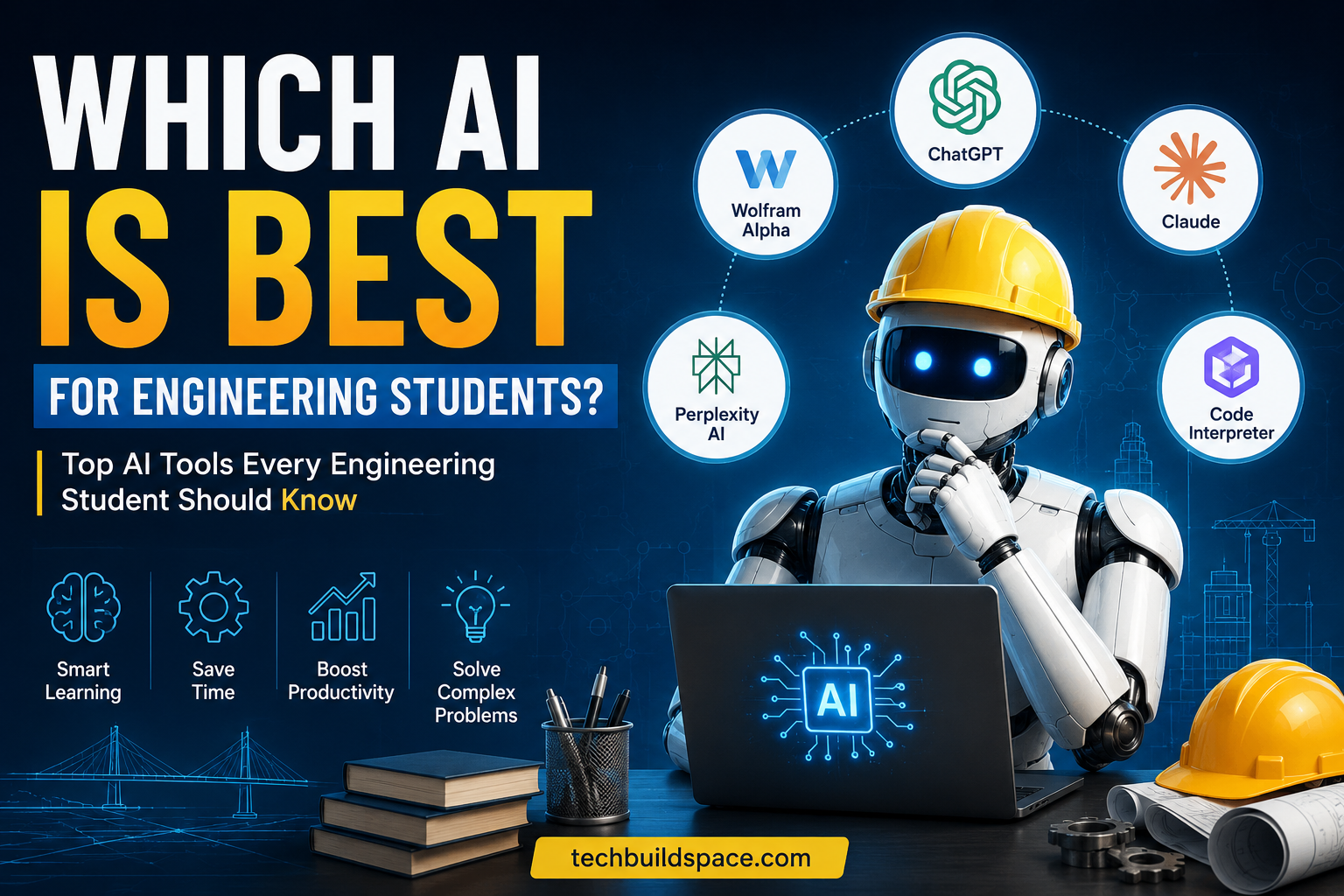
Finding Which AI Is Best for Engineering Students: A Guide to Smarter Learning
The engineering students have a distinct academic load. Their courses may include complicated math tasks, programming, lab experiments, technical writing, conducting research, project development, and challenging problems. In light of such an academic diversity, artificial intelligence could be very helpful if used properly. Instead of substituting the process of learning, AI could be used as a tutor who facilitates the process of learning and coping with the difficulties.
There is no single answer to the question of which AI is best for engineering students. The choice of AI depends on the specialization of the engineering student, his academic demands, and his goals. For example, the computer engineering students require help in coding, while the mechanical engineering students require math explanations and technical problem solving.
Which Features Engineering Students Must Consider When Choosing an AI Tool?
Firstly, choosing a platform for getting assistance must start with specifying what tasks the student needs to perform. An AI platform that works effectively when helping with writing can be useless for programming or solving math problems.
An important feature is to have an opportunity to have complex topics explained in easy-to-understand ways. Formulas, theories, and various processes in engineering can be hard to understand while using only a textbook. An effective AI assistant must be able to break down complicated topics into steps and give explanations to the student.
Another significant aspect of choosing a good AI assistant is its accuracy. The accuracy of calculations and technical data must be checked carefully. The students will prefer assistants who show not only a result but also the reasoning process and let them verify how the answer was received.
The third possible feature is coding support. The students of computer, electrical, robotics, or software engineering will find it useful to get explanations of programming algorithms, detect errors, and have suggestions of improvements.
AI for Mathematics and Problem-Solving
Students of many engineering disciplines will face math courses such as calculus, linear algebra, differential equations, statistics, numerical analysis, and others. AI can help to make the learning process more interesting and interactive.
Instead of requesting only the final answer, students will be able to ask for a step-by-step solution to a mathematical calculation and even explanations why some formula is applicable or where some error can occur in calculations.
A student who has difficulties with solving differential equations, for example, will be able to try solving a problem on his/her own and then ask an AI assistant to explain the algorithm of the solution. This way, it will be possible to identify where exactly the student’s understanding fails.
However, students should not consider an automatically calculated solution provided by AI as always being the right one. One tiny error made in an equation can yield an incorrect solution. It is vital to verify significant solutions with books, coursework, calculators, or instructors.
AI for Coding and Programming
Programming courses are becoming more common in engineering degrees. Depending on their speciality, the student will deal with one or another language – from Python to C++, Java, MATLAB, and others.
In such a case, AI could give assistance to students while learning how to programme. AI can help with interpreting unfamiliar code, finding possible errors in it, proposing alternative methods, and clarifying programming concepts.
Let us consider a student who created some Python program to analyze experimental data and faced an error message. Instead of asking AI to write a whole new program, one can give an error message and ask AI to clarify what the reason was.
Such an approach promotes understanding, not dependency.
Besides that, AI can give simpler interpretations of such notions as loops, functions, arrays, object-oriented programming, algorithms, and data structures, and the student will be able to use the explanation in his project.
It is necessary to know how the code works. To submit AI-generated code without understanding it will lead to big problems for a student when he would have to clarify the nature of the project or solve some task related to the code.
AI for Research and Technical Writing
Engineering students usually have to write a lot of laboratory reports, research papers, documents on projects, presentations, and summaries of technical information. Writing about a certain technical issue can be difficult even if the student knows what is going on.
An AI system can help students with the organization of information, making an outline, making sentences clear, and highlighting places that need an explanation.
For example, after a student finished some laboratory experiment and gathered all the results but couldn’t make an order in the discussion section. An AI tool could help the student to build an outline according to his results.
However, the student is supposed to be responsible for the accuracy of his/her work. All technical claims, statistics, citations, and research results should be compared with academic sources.
AI for Mechanical Engineering Students
Some of the topics in mechanical engineering include thermodynamics, fluid mechanics, materials science, manufacturing, mechanics, and computer-aided design. There are many ways through which AI could be used for assistance in these topics.
The student can utilize AI for revision, practice question generation, formula explanation, and comparisons among different engineering concepts.
For example, the student might know what entropy means in thermodynamics but will face difficulties applying it to a certain case. An AI assistant would provide an easier explanation or provide an illustration of that concept to help the student visualize it.
Moreover, AI could also assist students in preparing for their exams by generating practice questions on specific topics.
However, when it comes to engineering calculations involving design or safety-critical issues, students should use specific engineering software, engineering standards, calculations, and the instructor’s advice.
AI for Electrical and Electronics Engineering
Students of electrical and electronics engineering may work with circuits, signals, control systems, electronics, electromagnetics, embedded systems, and programming.
AI could be used to provide conceptual explanations of circuit phenomena and to show relations between different elements of the circuit. Students could also use it to detect errors in programming while using microcontrollers or embedded systems.
For example, a student who doesn’t understand why changes in resistance influence current in a circuit may get a conceptual explanation of the issue from AI and compare it with lectures and experimental measurements.
AI may help students to grasp technical terms and prepare revision questions.
Nonetheless, there are physical systems that need to be tested carefully. A response to a question given during text conversation could not take into account restrictions related to hardware, component specs, environmental conditions, and so on.
AI for Civil Engineering Students
The disciplines that civil engineers are taught include structural engineering, construction, transportation, geotechnical engineering, environmental engineering, and surveying.
With the help of AI, civil engineering students can prepare for the complex theories, understand concepts, arrange their reports, and design practice tasks.
For instance, while preparing for the exam, the student can request from AI to design questions on various kinds of structural loads. After completing those questions, the student will be able to evaluate which subjects need to be revised again.
AI can also assist in organizing large volumes of information in the process of preparing project documentation.
Nevertheless, decisions made by civil engineers may have a direct impact on people’s safety. Hence, one cannot fully rely on the general answers provided by AI concerning structural calculations, construction tasks, and other issues related to safety.
AI for Computer and Software Engineering
The study of computer and software engineering might greatly profit from AI since the subjects usually include programming, algorithms, databases, systems, software development, and problem solving.
AI can explain how certain algorithms function, evaluate the code written by students, and check for possible errors. Besides, AI may provide examples of certain topics and concepts, thus helping students understand difficult things better.
In terms of projects, AI will aid in brainstorming and planning. So, if a student is working on the development of a mobile app, he/she may use AI to find ideas and plan the development process and all the steps that should be taken, including all the questions that have to be answered.
However, the student himself/herself should work on design, implementation, and understanding of his/her project since problem-solving is the main skill for a future engineer.
AI for Studying and Exam Preparation
AI can be especially helpful when studying for examinations since it can transform revision into an active process of learning.
The student can make the AI program create questions, flashcards, clarify complex issues, or engage in a question-answer dialogue.
Thus, for instance, while preparing for an exam in materials engineering, the student can ask the AI to make practice questions dealing with material characteristics, testing, and modes of failure.
After doing those questions, the student will be able to determine the weak spots and put more effort into their improvement.
Moreover, one can ask the AI to explain the same concept in varying levels of complexity, starting from a relatively simple explanation and moving to a more complicated one.
This can help build understanding gradually.
Importance of Accuracy and Appropriateness Use of AI
An AI system should be evaluated not only on how fast it generates an answer. Engineering students require information that is precise, clear, and suitable to their academic context.
Sometimes AI systems may produce incorrect calculations, misleading explanations, and references that require verification. Since the answer may be provided in a quite convincing manner, students have to form the habit of verifying important pieces of information.
Which AI is best for engineering students? There are several ways to verify such answers: comparing them with information from textbooks, class materials, academic papers, reputable technical sources, engineering guidelines, and comments of teachers.
Students should also adhere to the requirements concerning AI usage at their academic institutions. Some courses allow the use of AI for brainstorming and editing; some courses do not allow it in assignments and examinations.
Appropriate use is when students use AI to enhance their knowledge, not to avoid learning.
Selection of the Proper AI for You
The most efficient AI will depend on your expectations from it.
In case understanding complicated theories poses the greatest problem for you, then select the tool that offers detailed explanation and interactive discussion. In case you spend much time programming, you will appreciate coding and debugging capabilities.
For students engaged in research, organization of information and improvement of technical writing may be priorities. Mathematical students may appreciate good reasoning and calculation features.
Ease of use is another thing to take into account. A powerful platform does not automatically mean useful—it may be complicated to use and understand its responses.
You should try different AI tools not because of their popularity, but based on your own academic experience.
FAQ
Are engineering students allowed to use AI for assignments?
Depends on the policy of the university, the professor, and the assignment itself. Students have to find out the policy on academic integrity and disclose AI assistance when necessary.
Is AI able to help with solving engineering problems accurately?
AI is able to help with many engineering problems, but it is crucial to verify the answers. Students should verify their calculations and explanations in relation to reliable academic sources.
Is AI helpful for first-year engineering students?
Yes. Beginner students can utilize AI to get easier explanations, examples, exercises, and assistance when dealing with complex concepts. It should be used as learning help, but not as a substitute for personal studies.
Can AI take the place of special engineering software?
Typically, it cannot. The specialized software is used for certain engineering calculations, modelling, simulations, and designs. AI can work along with these tools, but it does not automatically replace them.
What would be the best way to integrate AI when learning engineering?
Integrate AI as your personal tutor, problem solver, explanation bot, collaborator, and proofreader. Try to solve questions on your own first and then validate using AI.
Conclusion
To know which AI is best for engineering students, best would depend on the field the student studies, the way he/she learns, and his/her academic requirements. A computer engineering student would do best with the use of an AI to assist with programming and debugging. Mechanical engineering students, on the other hand, would find more useful an AI that helps them with their mathematics. There might be other requirements for research-orientated students.
The best thing to do is to use AI in partnership with oneself, as a tool that supplements and not replaces effort. The student should use AI along with the textbooks, lectures, engineering software, academic articles, lab work, and teacher’s assistance. Used this way, AI will make complex topics easier to understand, offer explanations that fit the needs of the individual, help prepare for exams, and enhance problem-solving skills of the student.










Post Comment