Entrepreneur vs Business Owner: Key Differences That Shape Success
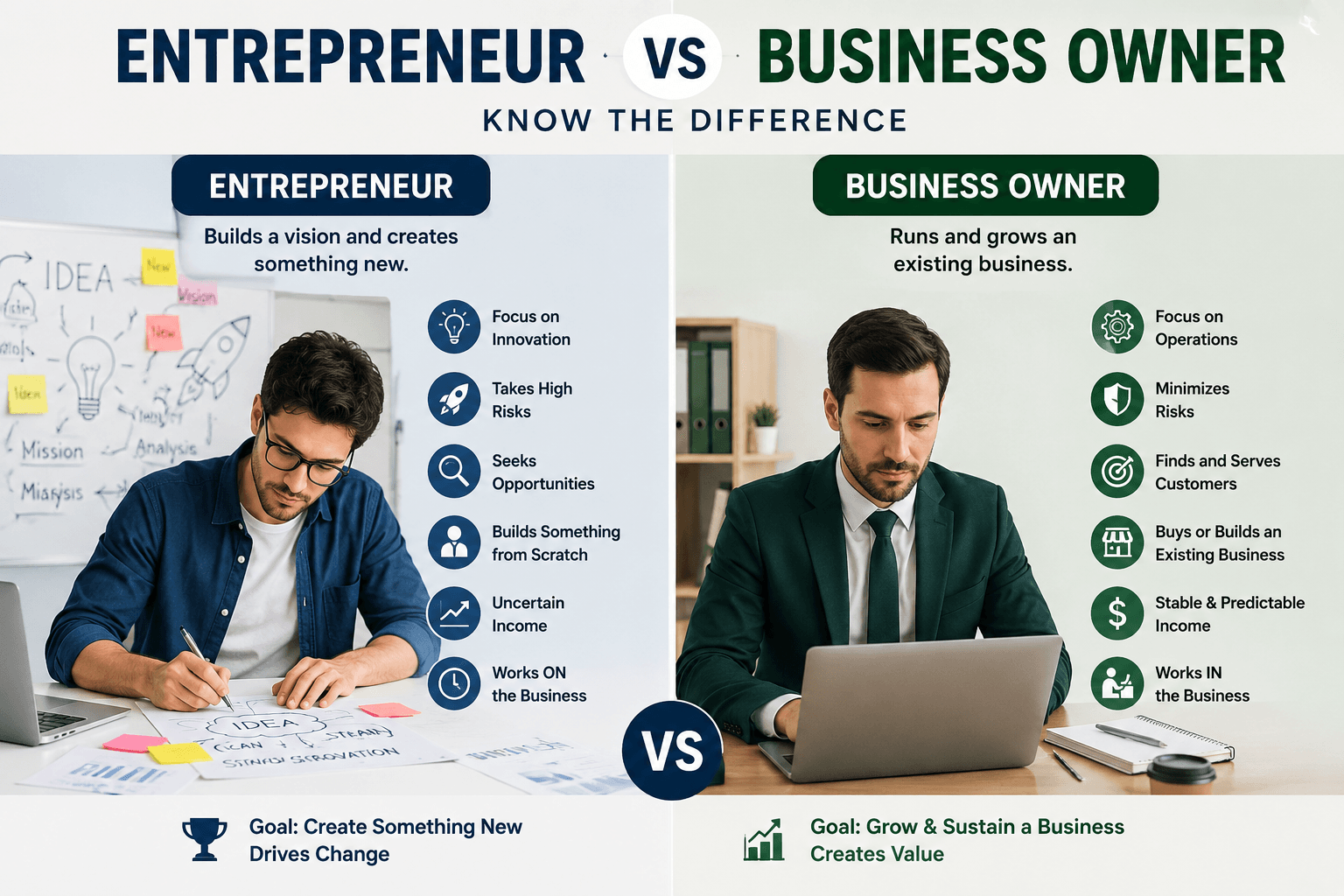
The choice whether to become an entrepreneur or merely to operate a business is something that not everyone considers until he or she finds himself or herself on one of these tracks. The entrepreneur vs business owner discussion is much deeper than the mere difference of titles—it involves different objectives, outlooks, degrees of risk, and visions.
Take two best friends graduating from college. One starts up a coffee shop in his/her neighbourhood for the love of his/her community and a reliable source of income. Another one devotes several months to developing a revolutionary technology for marketing the local cafés. Both do the same amount of effort, and both own businesses, but their roads are completely different.
Getting to know these differences can help you make a wise choice depending on what you want from your venture. Neither career is better—each one requires certain objectives, finances, and the ability to be flexible. This article will explain to you all the differences and similarities between these two roads.
Entrepreneur vs Business Owner Concept Clarification
To be able to compare the roles, first, it is necessary to comprehend what exactly these roles mean.
The business owner is the person owning a company and managing its work with the provision of certain goods or services. Such a person usually seeks to earn profit consistently and gain a source of stable income. Stability usually goes hand in hand with growth.
At the same time, the entrepreneur starts working with an idea or even problem and attempts to innovate, provide solutions to the issues, or change the current state of affairs in the industry. While financial success is very important for entrepreneurs, innovation and uniqueness usually play the main role.
In the case of the entrepreneur vs business owner comparison, it should be noted that a person may actually become both over time.
Reasons Behind the Confusion
There is one sole reason for the confusion—the fact that both are businessmen.
They both employ people, manage money, market their products, and serve their clients. And from the external point of view, their routine seems to be exactly alike. However, the reasons behind these activities might be different.
The businessman can be concerned about satisfying his customers and making his company successful each year.
For an entrepreneur, the following questions arise:
- Can this product change an industry?
- Can technology improve this service?
- Can this company expand worldwide?
This is what drives their decision-making processes at almost every turn.
1. Vision and Mission
The primary point of difference between the entrepreneur and the business owner is vision.
While a conventional business owner tends to found his enterprise on proven demand, entrepreneurs typically look for unfulfilled needs.
The traditional business owner sets up a grocery, an accounting firm, a bakery, or even a repair shop since he is aware that there is a need for such enterprises.
The entrepreneur, on the other hand, looks out for something that does not currently exist in the market and tries to create it.
Imagine the experience of two individuals scaling two different mountains – one along a tried-and-tested track and another blazing a trail.
2. Attitude Towards Risk
All businesses involve uncertainties, but entrepreneurs are generally willing to take more risks than business owners. Business owners usually tend to be very prudent, control their costs, and opt for a slow growth model. The decisions of the business owners are always based on safeguarding their gains.
Entrepreneurs tend to spend a lot on research and technology before they start making any money. They are aware of the possibilities of failure but still accept them because they go hand in hand with innovations.
Both ways are right. Some people sleep well thinking about their slow-growth businesses, while some people find excitement in pursuing innovative ideas.
3. Innovation and Stability
Another key difference is innovation.
Entrepreneurship involves searching for a more effective way of dealing with things. This includes new technology, approaches, and consumer experience.
Businessmen typically enhance what already exists rather than changing it from scratch. It means that their success is often based on providing great services instead of innovation.
Take a small restaurant owned by one’s family as an example. He can improve his recipes and services and increase the number of tables.
On the contrary, an entrepreneur would invent an app which would revolutionise the reservation process at the nationwide level.
4. Growth Expectations
Growth is defined differently based on your objectives.
For example, an entrepreneur might consider success to be having multiple branches, earning more money per year, or employing more people.
Business owners dream bigger. In fact, their dreams can even extend to becoming a national or international player or bringing in more investors.
This does not mean all entrepreneurs turn out to be millionaires or that all business owners love being small businesses. However, the scale is normally more important in entrepreneurship.
When comparing entrepreneurs and business owners, it is easy to see the difference in growth expectations.
5. Measures of Success
Each individual will have his or her own definition of success, depending on the path taken.
Some of the measures used by many businesspeople include:
- Profitability
- Customer loyalty
- Financial independence
- Sustainability
- Reputation
However, for entrepreneurs, success can be measured by:
- Disruption in the market
- Fast growth
- Influencing the industry
- Product innovation
- Funding from investors
This data affects day-to-day decision-making. While one individual can take delight in regular earnings every month, another individual takes delight in inventing a revolutionary product regardless of having less income.
While individuals tend to emphasise contrasts, similarities are just as important.
Entrepreneurs as well as business owners need leadership qualities.
Leadership skills are required from both entrepreneurs and business owners.
Discipline when it comes to finances is also required from both sides.
Competition exists for both.
They both go through failure.
They spend endless hours trying to solve emerging problems.
But most importantly, they both provide opportunities to other people through creating jobs.
The dispute about entrepreneur versus business owner can never imply that one way is more prestigious than the other. All companies, big or small, start with people who take steps towards success.
Right Mindset for Success
As you consider the choice of direction to follow, take some time to think about your values.
Do you like optimising existing processes and creating reliable streams of income?
Or do you find yourself imagining things that don’t even exist yet?
There are those who simply have a preference for structure and reliability. And there are those who are energised by unpredictability and experimentation.
As it turns out, many accomplished individuals tend to alternate between these two mindsets during their career life spans. An individual could start out as an entrepreneur with grand visions and turn into a businessperson committed to sustaining their business. Or they could go through the other way around as they gather years of experience.
Sometimes self-awareness is better than definitions.
6. Leadership Style
This aspect can make the comparison of an entrepreneur and a business owner even more interesting.
In general, business owners prefer to organise the team, its tasks, and the process. The key aim is to keep everything working well and satisfy customers.
Entrepreneurs, in their turn, can be described as visionary leaders. They motivate people around them because of their dreams and plans for the future.
There is no better way of leadership. It depends on the goals of the company and its development stage.
7. Funding and Investment
Different funding approaches can be used as well.
Personal savings, business income, or bank credits are the methods used by many business people to invest in their business. Usually, they want to have full control over their business.
In most cases, entrepreneurs are ready to accept any kind of investment. This is the way for them to get money that can help them to grow very fast. For this, they can lose part of their ownership.
This is because of different goals that they have in the long term. A stable business does not need to have millions of dollars.
8. Daily Priorities
The daily duties of these two may be similar, but their priorities usually vary.
The activities for a business owner in his daily life can be the following:
- Handling employees
- Meeting customers
- Checking accounts
- Arranging inventories
- Enhancing customer services
While those of an entrepreneur can be more about:
- Generating new ideas
- Meeting investors
- Testing products
- Forming alliances
- Studying future markets
They both work hard but have different results in mind.
9. Long-Term Goals
The last distinction between an entrepreneur and a businessman has to do with the long-term outlook.
Businessmen want to establish a business that would sustain their families over many decades. In time, many of them will hand down the business to the next generation or sell it after several years of successful operation.
Entrepreneurs tend to strive for fast expansion, followed by selling their business, going public, or establishing a new venture. Entrepreneurs like building a business more than running it.
Which Route Are You to Take?
The decision of which route to take depends on one’s own reflection of oneself.
One would be inclined to entrepreneurship if one
- Loves tackling new challenges.
- Is okay with risk.
- Wants to create something different.
- Likes fast-paced growth.
- Is innovative.
Someone who might be suited as a business owner would have the following characteristics:
- Prefers financial stability.
- Enjoys running operations.
- Likes building good customer relations.
- Grows at a predictable pace.
- Is independent.
It’s important to remember there is no wrong decision, and it is best if it fits your personality, goals, and way of life.
Common Misconceptions
There are a few myths associated with this subject matter.
One such myth is that all entrepreneurs end up rich. The truth of the matter is that not all enterprises are successful; some go bankrupt even before they break even, and those who succeed do so after a few years of hard work.
The other myth is that businessmen do not possess creativity. Nothing could be further from the truth, as being successful in business means creativity in all respects – marketing, problem-solving, customer service, and decision-making on a daily basis.
Entrepreneurs are thought to not value stability at all. Many entrepreneurs change their approach as their companies develop and start thinking more about sustainability.
The difference between the entrepreneur and the business owner blurs in some way as the business grows.
Practical Tips Before Making Up Your Mind
If you are still undecided about which path will suit you, then here are some practical tips for you:
- Understand your future career objectives.
- Find out what level of financial risk you can afford.
- Learn some basics of business management.
- Conduct extensive market research.
- Find good mentors and industry professionals.
- Begin small and adjust based on your experience.
Many successful careers start with experiments, not huge steps.
FAQs
Are all entrepreneurs business owners?
Yes, but eventually. When an entrepreneur sets up a company, he/she automatically becomes a business owner. But every business owner need not have been an entrepreneur since most business owners buy their businesses.
Which one is more profitable?
The profitability of a business depends more on how it is done than what you are called. Either can create a very profitable business.
Can one person be both?
Definitely. It is possible for people to start out as entrepreneurs making innovations and later become business owners who run a successful business.
Which path is riskier?
As a general rule, entrepreneurship carries a lot of risk in the form of finances and operations because entrepreneurs always venture into unknown territories.
Conclusion
It would be wrong to try to make someone pick between ‘entrepreneur’ and ‘business owner’ as if one had to choose between two alternatives. Rather, the difference lies in two distinct strategies of generating value.
Entrepreneurship entails a constant search for innovations and novel ideas that can help to change the industry. Business ownership involves the creation of reliable firms that bring steady income, take care of workers, and benefit society.
Both ways demand persistence, strength, and readiness to learn constantly. Both ways promote economic development and open doors for other people. Regardless of whether your goal is to become an entrepreneur who runs a revolutionary company or a business owner, the key to success still remains dedication and right decision-making.
In conclusion, the title is not that important at all—what counts is the outcome.










Post Comment