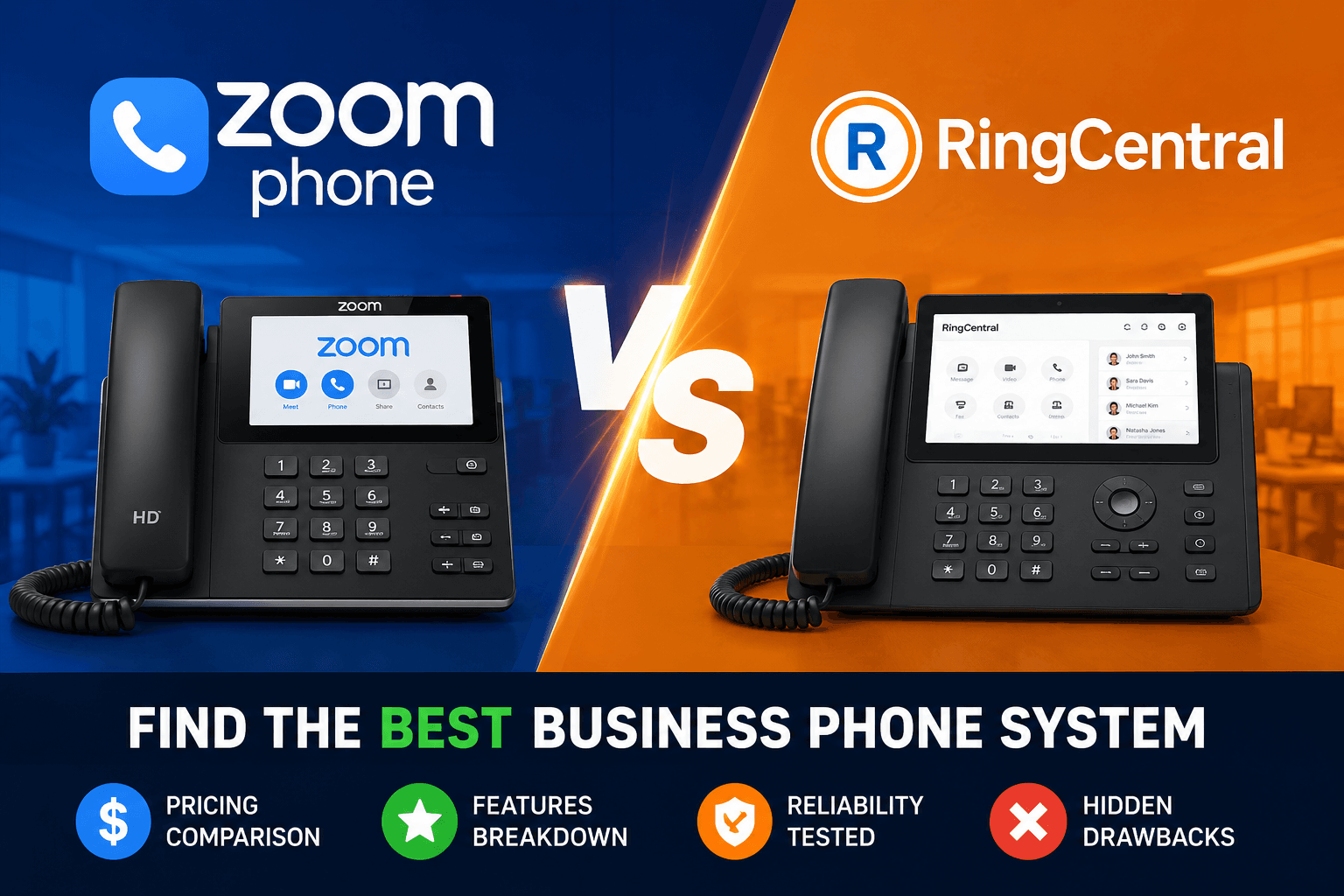
The Ultimate Business Calling Showdown: Zoom Phone vs RingCentral
Running a company in today’s world seems to be like conducting an orchestra. All your employees, customers, and partners expect perfect communication, wherever they are. Just a few years ago, Emma, a lady who owns a successful digital agency, found out that her old office phone system became an obstacle for further growth. Her remote workers had issues with calling, her customers asked for faster reactions, and using numerous communication services became quite a headache. Like any other business owner, she started to research Zoom Phone vs RingCentral.
She found out that both of those systems have their own advantages. The key point is not to rely only on marketing but to understand how each of them works and what kind of opportunities it provides.
This article will cover all aspects of Zoom Phone vs RingCentral and help you make the right choice.
The Reasons for Comparing Zoom Phone with RingCentral
Today’s cloud communication has changed the way firms communicate with their customers and staff members. Today’s phone system integrates telephone calls, messaging, video conferences, voicemail, and collaboration in one system.
And that is exactly the reason why the comparison of Zoom Phone vs RingCentral becomes increasingly popular with entrepreneurs.
Zoom Phone is based on Zoom’s renowned video conferencing software. Companies that use Zoom Meetings can enhance their communications with cloud telephony without bringing in any new technology.
On the other hand, RingCentral has developed its entire suite over the years. It concentrates on giving businesses enhanced voice communication services, messaging, meetings, and administration capabilities.
Both solutions provide good communication features; however, only one is better depending on your business.
The Key Components
In assessing Zoom Phone vs RingCentral, the key is to understand their key components.
- HD voice calling
- SMS Messaging
- Voicemail Transcription
- Call forwarding
- Auto attendants
- Video meeting integration
- Mobile and desktop applications
Features similar to these but with more advanced administrative functions are available in RingCentral, along with advanced reporting, call routing, and enterprise management features.
However, for smaller firms, all that Zoom Phone has may be sufficient without any additional complications.
Pricing That Fits Different Businesses
Budget plays an important role when selecting communication software.
Zoom Phone offers flexible pricing that works especially well for businesses already paying for Zoom Workplace. Bundled subscriptions can reduce overall communication expenses.
RingCentral offers multiple pricing plans with progressively advanced capabilities. Although pricing may appear higher initially, many organisations value the additional business tools included.
The comparison between Zoom Phone vs RingCentral is not just about choosing the one that is cheaper to subscribe to every month. In some cases, a higher subscription fee may help to save money in the future by improving productivity.
It’s better to choose the features that will be used by the company on a daily basis.
Experience Matters
Another aspect that many people overlook is the extent of the employees’ buy-in.
Zoom Phone has been made to be easy to use. Most people who have used Zoom Meetings are able to start calling for business right away.
RingCentral offers a great dashboard loaded with all sorts of communication tools. Though it is great, some users need further training to get used to it.
During one office rollout, a small marketing team switched to Zoom Phone because their staff already understood the interface. The training process was completed much sooner than anyone thought, minimising downtime. The process proved to be much more smooth than anticipated.
Such stories make it quite clear why the Zoom Phone versus RingCentral discussions involve usability as well.
More Than Just Voice Calling
The use of business communications involves much more than just making a voice call.
All three platforms offer functionalities such as instant messaging, voice messaging, video calls, and collaboration.
Zoom Phone integrates well with Zoom Meetings to allow users to switch from voice calls to video calls at once.
RingCentral brings all forms of communication, collaboration, file transfer, and meetings on a single platform.
When comparing Zoom Phone to RingCentral, businesses need to look at how their employees communicate during a day’s work.
Integrations With Other Business Tools
The value of a communications platform will increase exponentially if it is integrated with the software already used by your company. Integrations will not only save your employees’ time but will also make their work less manual.
As far as Zoom Phone vs RingCentral are concerned, both platforms work great but in a somewhat different way.
While Zoom Phone integrates perfectly with Zoom Workplace, as well as Microsoft 365, Google Workspace, Salesforce, Slack, and many other business solutions, companies already using Zoom services may easily get used to the platform.
RingCentral created one of the largest libraries of integrations in the market. This communication platform integrates with more than hundreds of applications, which makes it appealing to businesses that use a number of software products.
Integration becomes essential for companies with complex workflows.
Experience on the Go for Remote Workforce
Today’s employees no longer sit back at the same desk during each working hour. Flexible work and remote working necessitate a means of communication that is accessible at all times.
The company Zoom Phone provides reliable mobile apps for Android and iOS devices. It is possible for employees to make business calls, receive voicemail, send messages, and join virtual meetings through an interface they are already familiar with.
RingCentral, too, provides a neat experience on mobile by providing voice calls, messaging, video meetings, and collaboration through the same application.
When it comes to a comparison of Zoom Phone vs RingCentral, the two have much in common due to their flexible nature.
Security and Reliability
Business discussions usually involve some sensitive information, and therefore, the security aspect is very important.
Zoom Phone ensures security of the communications by means of encryption, secure authentication, administration features and regular software updates. Over time, Zoom Phone has made efforts to increase the level of security in line with the needs of modern businesses.
RingCentral also gives much importance to enterprise-level security through encryption, compliance certifications, and administration. Many large companies tend to appreciate the strong approach to governance and data security in RingCentral.
In comparing Zoom Phone and RingCentral, enterprises do not have to worry about security issues, as both providers deliver reliable solutions.
Reliability is no less important than security. Lack of it may affect customers’ relations, staff performance and sales. Fortunately, both platforms provide highly reliable cloud-based communication services.
Customer Support
However, even great software needs help once in a while.
Zoom offers documentation, tutorials, a knowledge base, and different customer support services depending on the plan chosen. For customers who already use Zoom, getting help comes easily due to the presence of plenty of learning materials.
RingCentral is known for its extensive support services. Companies have access to phone support, an online help centre, onboarding, and implementation services.
The quality of support is one of the aspects that determine which option companies choose between Zoom Phone and RingCentral.
Scaling for Future Growth
Selecting a communication solution is not only about meeting current requirements. Companies should think about their growth over the next two or five years as well.
Zoom Phone scales easily as your company grows. Extra users, phone numbers, divisions, and other options can be added easily and effortlessly. New businesses may find this feature very appealing since they have growing communication requirements.
RingCentral is also great at scaling its services. Advanced management options of RingCentral make it a good choice for mid-size businesses and enterprises with many branches or international teams.
The scalability aspect is among those important issues that should be considered when discussing Zoom Phone vs RingCentral, as a change can turn out to be quite expensive and time-consuming.
Which Platform Is Right for Your Business?
It’s not the same for everyone.
Zoom Phone is favoured by small companies, start-ups, consultants, and remote-only businesses because of its user-friendly interface and excellent integration with video conferencing services.
If you need an enhanced feature set such as call management capabilities, detailed reports, and many more integrations, then RingCentral would be the choice for you.
In the end, picking Zoom Phone vs RingCentral comes down to the specific needs of your company based on its size, communication style, technological needs, and expansion plans.
Advantages & Disadvantages
All means of communications have their own advantages and disadvantages. Knowing both is beneficial for organisations while making the right choice.
Zoom Phone
Pros
- Simple to install and operate.
- Very good compatibility with Zoom Meetings.
- User-friendly interface.
- Good value pricing for Zoom users.
- Good choice for remote/hybrid workplaces.
Cons
- Fewer call management features compared to other companies.
- Smaller integration library compared to RingCentral.
- Some enterprise features require higher-tier plans.
RingCentral
Pros
- Wide range of features available to companies of all sizes.
- Sophisticated analytics and reporting capabilities.
- High degree of integration with other applications.
- Robust call routing and management features.
- Great scalability for expanding companies.
Cons
- Prices might be higher for small companies.
- All these features will make the learning process more complicated.
- It will require time to set up all the necessary things.
In case of Zoom Phone versus RingCentral, the most optimal choice is based on what your company is after – simplicity or functionality.
Side-by-Side Comparison
| Feature | Zoom Phone | RingCentral |
| Ease of Setup | Excellent | Very Good |
| Voice Quality | Excellent | Excellent |
| Video Meetings | Outstanding | Excellent |
| Mobile Apps | Excellent | Excellent |
| Third-Party Integrations | Good | Excellent |
| Analytics | Good | Advanced |
| Scalability | High | Very High |
| Best For | Small to Mid-Sized Businesses | Mid-Sized Businesses & Enterprises |
In such a way, it becomes evident how Zoom Phone competes with RingCentral, as both platforms perform really well in different industries.
FAQ
Is Zoom Phone cheaper than RingCentral?
Zoom Phone can be considered a cheaper alternative in comparison with RingCentral if you have integrated the Zoom Workplace suite in your business. When comparing Zoom Phone and RingCentral, you need to pay attention to the list of services provided, not only pricing per month.
Which solution is more convenient to use?
Zoom Phone is more convenient to use because of its convenient interface and usability. User convenience is one of the main reasons why people compare Zoom Phone vs RingCentral.
Which solution will fit better for working remotely?
Both platforms work very well for remote teams with the help of cloud-based communication solutions. However, companies that rely extensively on video collaboration tend to choose Zoom Phone in the Zoom Phone vs RingCentral competition.
Are both solutions scalable to my company?
Absolutely. Both platforms are scalable and able to support any growing team, multiple locations, and other aspects of expanding communication requirements. Scalability is one of the reasons for comparing Zoom Phone vs RingCentral.
The Right Choice
Let’s go back a year later and see how Emma is doing. Her staff can now communicate via the phone with customers while working from home, conduct video meetings for collaboration purposes, and easily switch from message-based to voice communications without the need to use another app.
This situation shows us one valuable lesson. When it comes to the question of choosing Zoom Phone vs RingCentral, it is not about picking the most widely used platform. It is about picking the platform that fits your company’s operations.
In case you prioritise such things as simplicity, video calls, and easy adoption, then Zoom Phone is an excellent choice for you.
Otherwise, if you require advanced call routing, enterprise management, detailed reports, and a wide variety of integration options, then RingCentral may serve your purposes better.
Proper evaluation of Zoom Phone vs RingCentral prior to making the investment is critical.
Conclusion
Choosing a cloud communication tool is an important choice, as it affects the employees, customers, and the general operations of the business. In this article, we’ve covered such topics as pricing, usability, integration with other tools, security, scalability, customer service, and value overall to make a thorough comparison of Zoom Phone vs RingCentral.
The question of which platform is superior doesn’t have an answer since each company has its unique aims. Small firms find Zoom Phone easy to use and convenient, while bigger companies might get advantages from RingCentral administration tools.
To help with the decision-making process, one should make a list of their communication needs, project future development, and choose the functions that will be really used. This will facilitate choosing between Zoom Phone and RingCentral.
Finally, comparing Zoom Phone vs RingCentral isn’t as important as picking a platform which will match the business strategy.





Post Comment